These examples highlight custom products successfully delivered by Precision Polymer Technologies. They cover single-molecular-weight precision PEG and its derivatives, precision PEG lipids, bioconjugation materials, and functional precision polymers. They illustrate our capabilities in molecular design, precision synthesis, structural characterization, and quality control for biopharmaceutical and advanced materials research.
Y-ShapedTwo-Arm PEG
Click to enlarge
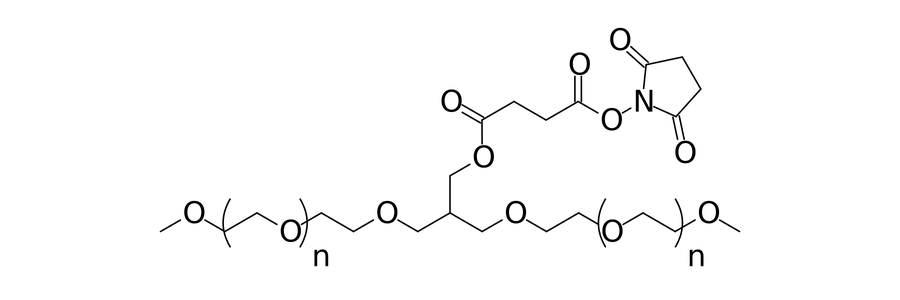
Two-Arm mPEG Succinimidyl Succinate
Y-(mPEG)2-Succinate-NHS
We completed custom synthesis and delivery of a Y-shapedtwo-arm PEG with a succinimidyl succinate group. The narrow-dispersity PEG arms had an average molecular weight of 10,000 Da (10 kDa) per arm. A succinate ester spacer carries a single NHS ester, which couples with a primary amine to introduce both PEG arms at one site. This design is suited to PEGylation studies on proteins, peptides, and amine-functionalized surfaces. We offer custom arm molecular weights of 1,000,2,000,5,000,10,000, and 20,000 Da, with options to tailor the branching core, spacer, and terminal group. We support each project with molecular design, process development, purification, and analytical characterization. Quality assessment can include molecular weight distribution, structural confirmation, and NHS ester reactivity, as appropriate.
Click to enlarge
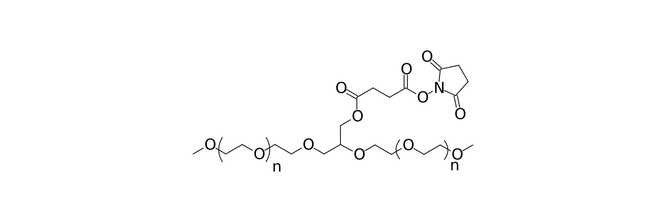
Asymmetric Two-Arm mPEG Succinimidyl Succinate
Asym-Y-(mPEG)2-Succinate-NHS
We completed custom synthesis and delivery of an asymmetric Y-shapedtwo-arm PEG with a succinimidyl succinate group. The narrow-dispersity PEG arms had an average molecular weight of 10,000 Da (10 kDa) per arm. The two methoxy-capped PEG arms attach to the branching center through different ether linkages. A succinate ester spacer presents a single NHS ester for amide coupling with primary amines. The reagent is suitable for protein and peptide conjugation and comparative studies of branched PEG architectures. We offer custom arm molecular weights of 1,000,2,000,5,000,10,000, and 20,000 Da, with options to tailor the branching core, spacer, and terminal group. We support each project with molecular design, process development, purification, and analytical characterization. Quality assessment can include molecular weight distribution, structural confirmation, and NHS ester reactivity, as appropriate.
Click to enlarge
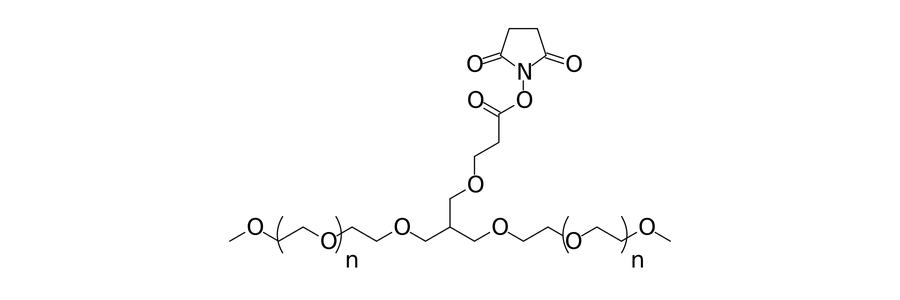
Two-Arm mPEG Succinimidyl Butanoate
Y-(mPEG)2-Butanoate-NHS
We completed custom synthesis and delivery of a Y-shapedtwo-arm PEG with a succinimidyl butanoate group. The narrow-dispersity PEG arms had an average molecular weight of 10,000 Da (10 kDa) per arm. The ether-linked butanoate spacer provides a stable linkage after coupling, making this reagent suitable for PEGylation studies on proteins, peptides, and other biomolecules where linkage stability matters. We offer custom arm molecular weights of 1,000,2,000,5,000,10,000, and 20,000 Da, with options to tailor the branching core, spacer, and terminal group. We support each project with molecular design, process development, purification, and analytical characterization. Quality assessment can include molecular weight distribution, structural confirmation, and NHS ester reactivity, as appropriate.
Click to enlarge
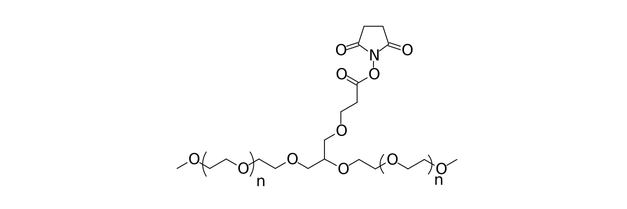
Asymmetric Two-Arm mPEG with an Ether-Linked NHS Ester
Asym-Y-(mPEG)2-Ether-NHS
We completed custom synthesis and delivery of an asymmetric Y-shapedtwo-arm PEG with an ether-linked NHS ester. The narrow-dispersity PEG arms had an average molecular weight of 10,000 Da (10 kDa) per arm. The two methoxy-capped PEG arms connect to the branching center through different linkages: a methylene ether on one side and a direct ether bond on the other. A single NHS ester couples with primary amines, allowing studies of how asymmetric branching affects protein and peptide PEGylation. We offer custom arm molecular weights of 1,000,2,000,5,000,10,000, and 20,000 Da, with options to tailor the branching core, spacer, and terminal group. We support each project with molecular design, process development, purification, and analytical characterization. Quality assessment can include molecular weight distribution, structural confirmation, and NHS ester reactivity, as appropriate.
Click to enlarge
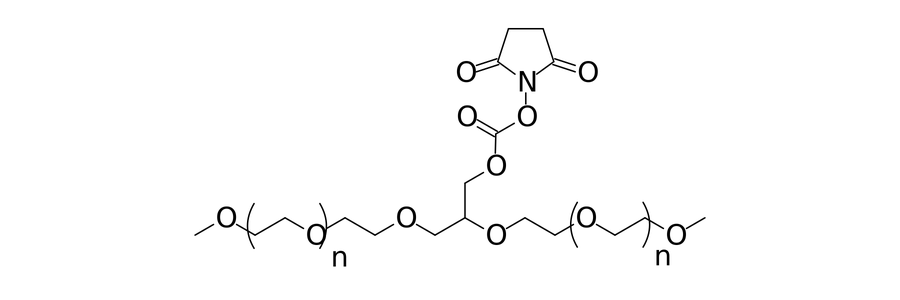
Asymmetric Two-Arm mPEG Succinimidyl Carbonate
Asym-Y-(mPEG)2-SC
We completed custom synthesis and delivery of an asymmetric Y-shapedtwo-arm PEG bearing a succinimidyl carbonate. The narrow-dispersity PEG arms had an average molecular weight of 10,000 Da (10 kDa) per arm. One methoxy-capped PEG arm connects through a methylene ether linkage, while the other connects directly through an ether oxygen. A single succinimidyl carbonate reacts with primary amines to form a carbamate. This design is suited to comparative studies of branched PEG architectures and biomolecule conjugation. We offer custom arm molecular weights of 1,000,2,000,5,000,10,000, and 20,000 Da, with options to tailor the branching core, spacer, and terminal group. We support each project with molecular design, process development, purification, and analytical characterization. Quality assessment can include molecular weight distribution, structural confirmation, and succinimidyl carbonate reactivity, as appropriate.
Click to enlarge
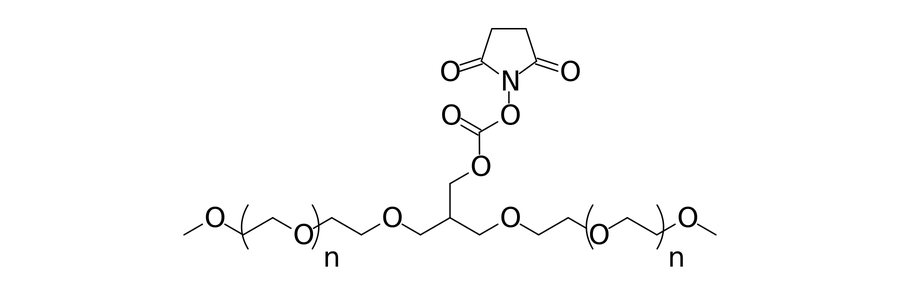
Symmetric Two-Arm mPEG Succinimidyl Carbonate
Sym-Y-(mPEG)2-SC
We completed custom synthesis and delivery of a symmetric Y-shapedtwo-arm PEG bearing a succinimidyl carbonate. The narrow-dispersity PEG arms had an average molecular weight of 10,000 Da (10 kDa) per arm. Both methoxy-capped PEG arms attach to the central carbon through equivalent methylene ether linkages. A single succinimidyl carbonate reacts with primary amines to form a carbamate, enabling branched PEGylation studies on proteins, peptides, and amine-functionalized surfaces. We offer custom arm molecular weights of 1,000,2,000,5,000,10,000, and 20,000 Da, with options to tailor the branching core, spacer, and terminal group. We support each project with molecular design, process development, purification, and analytical characterization. Quality assessment can include molecular weight distribution, structural confirmation, and succinimidyl carbonate reactivity, as appropriate.
Click to enlarge
Lysine-CoredTwo-Arm mPEG NHS Ester
Y-(mPEG)2-Lys-NHS
We completed custom synthesis and delivery of a lysine-coredY-shapedtwo-arm PEG bearing an NHS ester. The narrow-dispersity PEG arms had an average molecular weight of 10,000 Da (10 kDa) per arm. Carbamate linkages attach one methoxy-capped PEG arm to each of the α- and ε-amino groups of lysine. The carboxyl group is activated as a single NHS ester for amide coupling with primary amines, enabling branched PEGylation of proteins, peptides, and amine-functionalized surfaces. We offer custom arm molecular weights of 1,000,2,000,5,000,10,000, and 20,000 Da, with options to tailor the branching core, spacer, and terminal group. We support each project with molecular design, process development, purification, and analytical characterization. Quality assessment can include molecular weight distribution, structural confirmation, and NHS ester reactivity, as appropriate.
Click to enlarge
Lysine-CoredTwo-Arm mPEG Carboxylic Acid
Y-(mPEG)2-Lys-COOH
We completed custom synthesis and delivery of a lysine-coredY-shapedtwo-arm PEG bearing a free carboxyl group. The narrow-dispersity PEG arms had an average molecular weight of 10,000 Da (10 kDa) per arm. Carbamate linkages attach one methoxy-capped PEG arm to each of the α- and ε-amino groups of lysine, leaving a free carboxyl group. This group can be converted to an NHS ester or activated for coupling with primary amines. The material is suitable for developing branched PEG intermediates and studying biomolecule modification. We offer custom arm molecular weights of 1,000,2,000,5,000,10,000, and 20,000 Da, with options to tailor the branching core, spacer, and terminal group. We support each project with molecular design, process development, purification, and analytical characterization. Quality assessment can include molecular weight distribution, structural confirmation, and carboxyl end-group characterization, as appropriate.
Click to enlarge
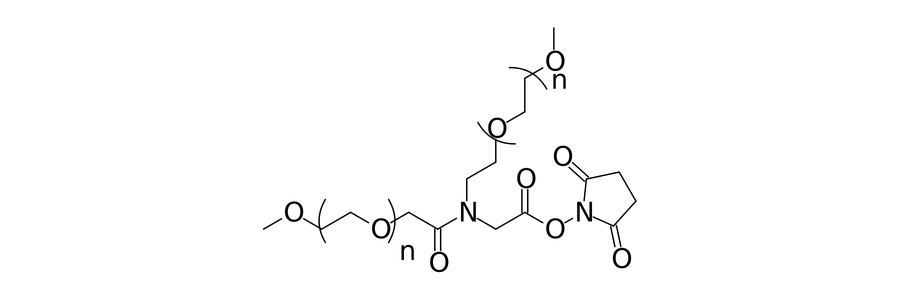
Tertiary-AmideTwo-Arm mPEG NHS Ester
Y-(mPEG)2-Amide-NHS
We completed custom synthesis and delivery of a tertiary-amideY-shapedtwo-arm PEG bearing an NHS ester. The narrow-dispersity PEG arms had an average molecular weight of 10,000 Da (10 kDa) per arm. The two methoxy-capped PEG arms connect to a common tertiary amide nitrogen through different linkages. The glycine-derived end carries a single NHS ester that forms an amide with a primary amine, enabling biomolecule conjugation and grafting onto amine-functionalized materials. We offer custom arm molecular weights of 1,000,2,000,5,000,10,000, and 20,000 Da, with options to tailor the branching core, spacer, and terminal group. We support each project with molecular design, process development, purification, and analytical characterization. Quality assessment can include molecular weight distribution, structural confirmation, and NHS ester reactivity, as appropriate.
Linear and Cyclic PEG
Click to enlarge
Discrete PEG Dimethyl Ether
mPEG-OMe
Precision PEG (PEG segment: approximately 2.0 kDa). This linear precision PEG has 45 ethylene glycol units and two methoxy caps, leaving no free hydroxyl or primary amine. It serves as an end-capped reference for studying how PEG chain length and end groups affect physical properties and formulation behavior. Purified samples are available at the specified degree of polymerization. Applications: mass spectrometry reference; polymer property studies; formulation screening. Custom synthesis available.
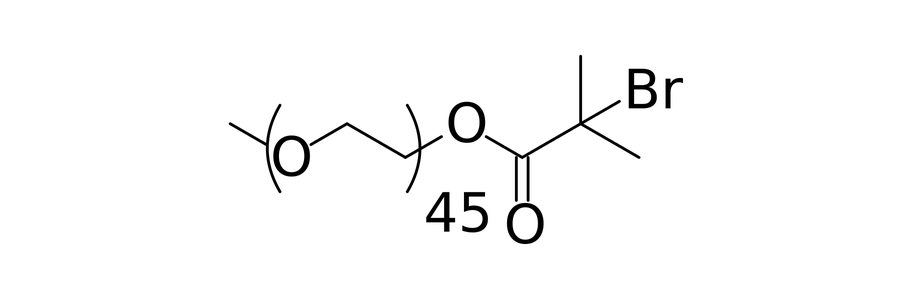
Precision PEG (PEG segment: approximately 2.0 kDa). This precision PEG contains 45 ethylene glycol units, a methoxy cap, and a terminal 2-bromoisobutyrate ester. With a suitable catalyst system, the brominated end initiates atom transfer radical polymerization (ATRP) to build block copolymers from the PEG segment. Purified macroinitiator and agreed end-group characterization are available. Applications: block copolymer synthesis; controlled radical polymerization; functional coatings. Custom synthesis available.
Click to enlarge
Cyclic PEG24
cPEG (n=24)
Precision PEG (PEG segment: approximately 1.06 kDa). This cyclic PEG is formed by joining ethylene glycol repeat units into a closed ring. With no free end groups, it provides a reference for comparing the topology and physical properties of cyclic and linear PEG. Purified samples and agreed structural characterization are available. Applications: polymer topology; host–guest studies; reference materials. Custom synthesis available.
Click to enlarge
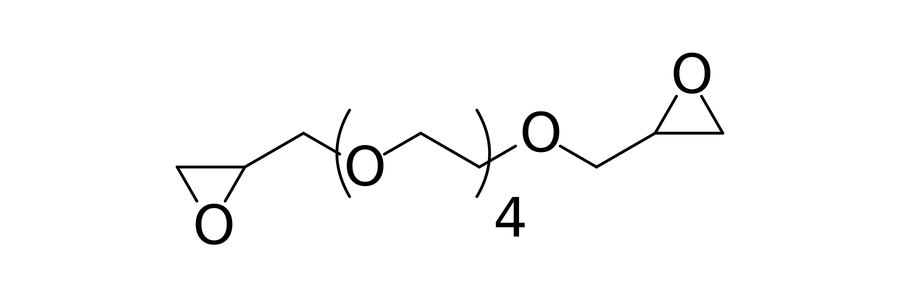
Discrete PEG4 Diglycidyl Ether
Glycidyl-PEG-Glycidyl(n=4)
CAS: 17626-93-6
Precision PEG (PEG segment: approximately 0.18 kDa). This homobifunctional precision PEG has 4 ethylene glycol units and a glycidyl ether at each end. The epoxides undergo ring opening with suitable amines or thiols, providing a hydrophilic spacer of defined length for molecular bridging or crosslinking. Purified samples are available, with end-group characterization on request. Applications: epoxide ring-opening conjugation; hydrogel crosslinking; surface grafting. Custom synthesis available.
Click to enlarge
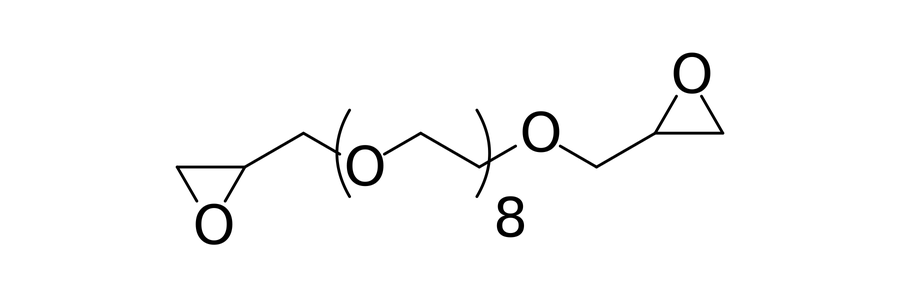
Discrete PEG8 Diglycidyl Ether
Glycidyl-PEG-Glycidyl(n=8)
CAS: 33918-21-7
Precision PEG (PEG segment: approximately 0.35 kDa). This homobifunctional precision PEG has 8 ethylene glycol units and a glycidyl ether at each end. The epoxides undergo ring opening with suitable amines or thiols, providing a hydrophilic spacer of defined length for molecular bridging or crosslinking. Purified samples are available, with end-group characterization on request. Applications: epoxide ring-opening conjugation; hydrogel crosslinking; surface grafting. Custom synthesis available.
Click to enlarge
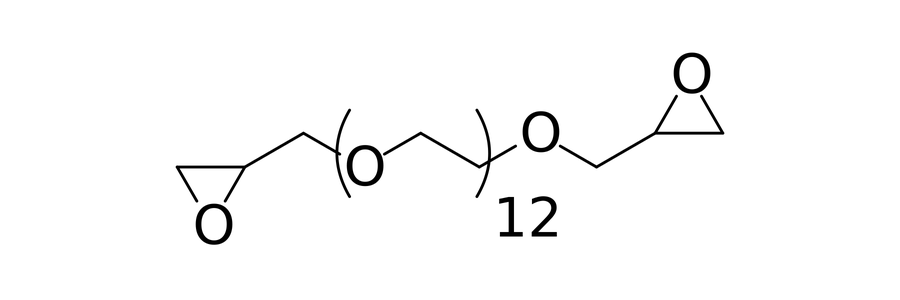
Discrete PEG12 Diglycidyl Ether
Glycidyl-PEG-Glycidyl(n=12)
Precision PEG (PEG segment: approximately 0.53 kDa). This homobifunctional precision PEG has 12 ethylene glycol units and a glycidyl ether at each end. The epoxides undergo ring opening with suitable amines or thiols, providing a hydrophilic spacer of defined length for molecular bridging or crosslinking. Purified samples are available, with end-group characterization on request. Applications: epoxide ring-opening conjugation; hydrogel crosslinking; surface grafting. Custom synthesis available.
Click to enlarge
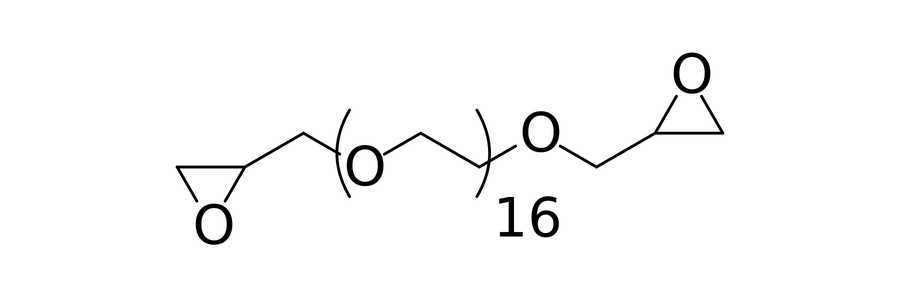
Discrete PEG16 Diglycidyl Ether
Glycidyl-PEG-Glycidyl(n=16)
Precision PEG (PEG segment: approximately 0.70 kDa). This homobifunctional precision PEG has 16 ethylene glycol units and a glycidyl ether at each end. The epoxides undergo ring opening with suitable amines or thiols, providing a hydrophilic spacer of defined length for molecular bridging or crosslinking. Purified samples are available, with end-group characterization on request. Applications: epoxide ring-opening conjugation; hydrogel crosslinking; surface grafting. Custom synthesis available.
Click to enlarge
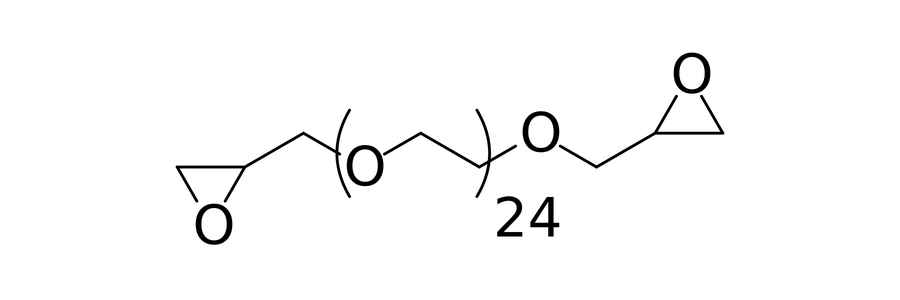
Discrete PEG24 Diglycidyl Ether
Glycidyl-PEG-Glycidyl(n=24)
Precision PEG (PEG segment: approximately 1.06 kDa). This homobifunctional precision PEG has 24 ethylene glycol units and a glycidyl ether at each end. The epoxides undergo ring opening with suitable amines or thiols, providing a hydrophilic spacer of defined length for molecular bridging or crosslinking. Purified samples are available, with end-group characterization on request. Applications: epoxide ring-opening conjugation; hydrogel crosslinking; surface grafting. Custom synthesis available.
Click to enlarge
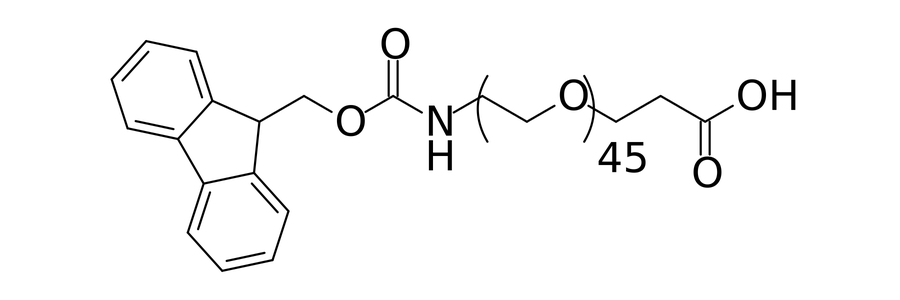
Fmoc-ProtectedAmino-PEG45 Propionic Acid
FmocNH-PEG-CH2CH2COOH(n=45)
Precision PEG (PEG segment: approximately 2.0 kDa). This heterobifunctional precision PEG has 45 ethylene glycol units, an Fmoc-protected amine, and a terminal propionic acid group. The activated carboxyl group forms an amide with a primary amine. Fmoc removal under compatible basic conditions exposes a primary amine for the next coupling step. Purified samples and agreed chain-length and end-group characterization are available. Applications: sequential bioconjugation; solid-phase peptide synthesis; hydrophilic linker design. Custom synthesis available.
Click to enlarge
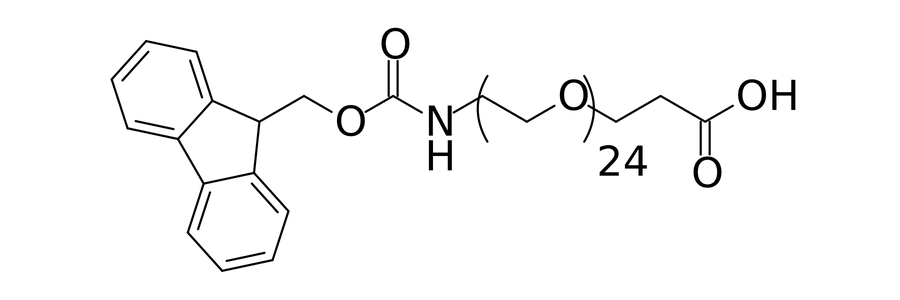
Fmoc-ProtectedAmino-PEG24 Propionic Acid
FmocNH-PEG-CH2CH2COOH(n=24)
CAS: 2170484-59-8
Precision PEG (PEG segment: approximately 1.06 kDa). This heterobifunctional precision PEG has 24 ethylene glycol units, an Fmoc-protected amine, and a terminal propionic acid group. The activated carboxyl group forms an amide with a primary amine. Fmoc removal under compatible basic conditions exposes a primary amine for the next coupling step. Purified samples and agreed chain-length and end-group characterization are available. Applications: sequential bioconjugation; solid-phase peptide synthesis; hydrophilic linker design. Custom synthesis available.
Click to enlarge
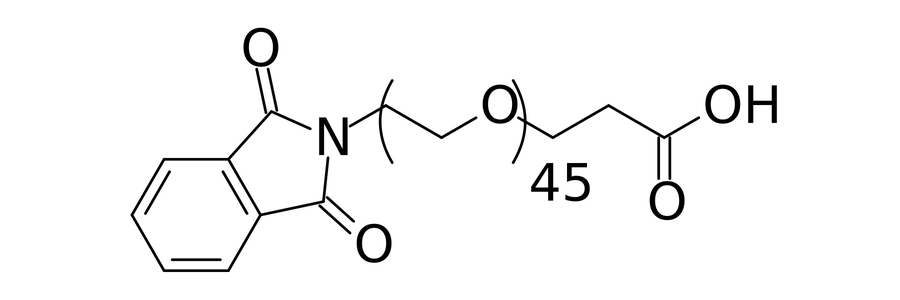
Phthalimide-ProtectedAmino-PEG45 Propionic Acid
PhthN-PEG-CH2CH2COOH(n=45)
Precision PEG (PEG segment: approximately 2.0 kDa). This heterobifunctional precision PEG has 45 ethylene glycol units, a phthalimide-protected amine, and a terminal propionic acid group. The carboxyl group can be activated for amide coupling with a primary amine. Deprotection under conditions compatible with the substrate exposes the PEG amine for further coupling. Purified samples are available at the specified chain length. Applications: amino-PEG intermediates; sequential conjugation; hydrophilic spacer design. Custom synthesis available.
Click to enlarge
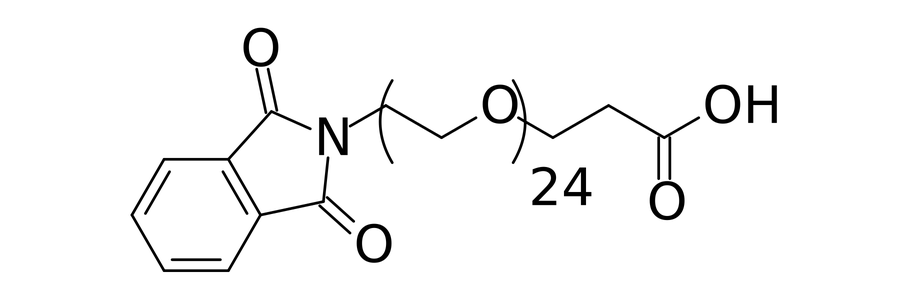
Phthalimide-ProtectedAmino-PEG24 Propionic Acid
PhthN-PEG-CH2CH2COOH(n=24)
Precision PEG (PEG segment: approximately 1.06 kDa). This heterobifunctional precision PEG has 24 ethylene glycol units, a phthalimide-protected amine, and a terminal propionic acid group. The carboxyl group can be activated for amide coupling with a primary amine. Deprotection under conditions compatible with the substrate exposes the PEG amine for further coupling. Purified samples are available at the specified chain length. Applications: amino-PEG intermediates; sequential conjugation; hydrophilic spacer design. Custom synthesis available.
PEG-Conjugated Dyes
Click to enlarge
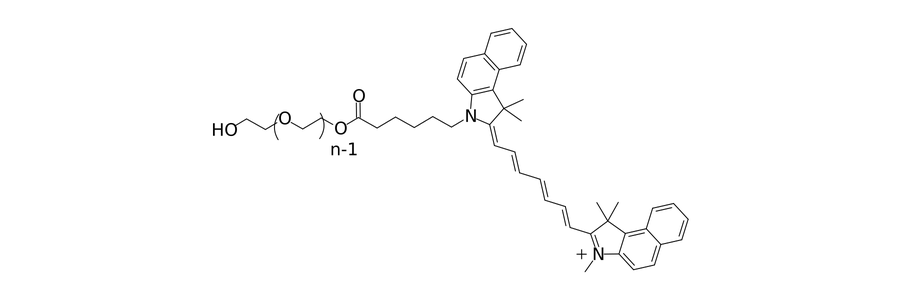
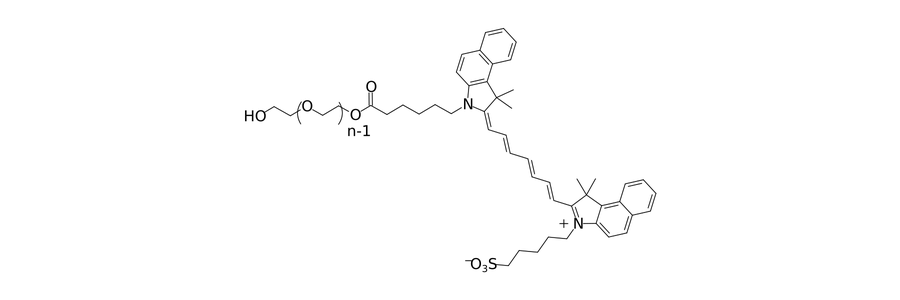
Hydroxy-PEG Conjugate of Benzoindole Heptamethine Cyanine
Cy7.5-PEG-OH
Precision PEG (PEG segment: approximately 2.1 kDa). An ester links a benzoindole heptamethine cyanine chromophore to a precision PEG spacer. The PEG segment in parentheses contains 47 repeat units. Custom PEG chain lengths are available at degrees of polymerization of 16, 24, 32, 45, or 64. The terminal hydroxyl can be esterified or further activated to make conjugation derivatives. Purified dye is available at the specified chain length, with salt form and characterization agreed on request. Applications: near-infrared probe development; fluorescent surface modification; materials tracing. Custom synthesis available.
Click to enlarge
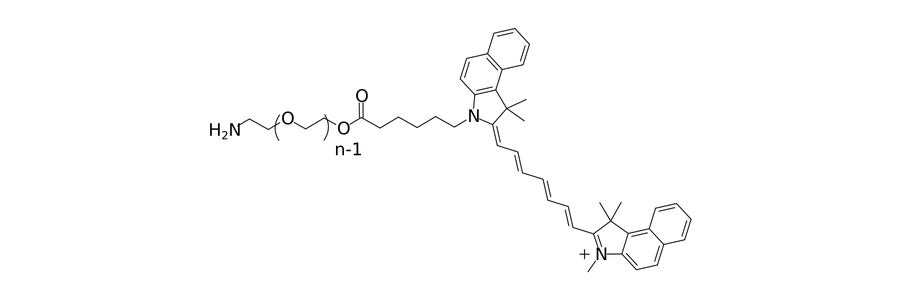
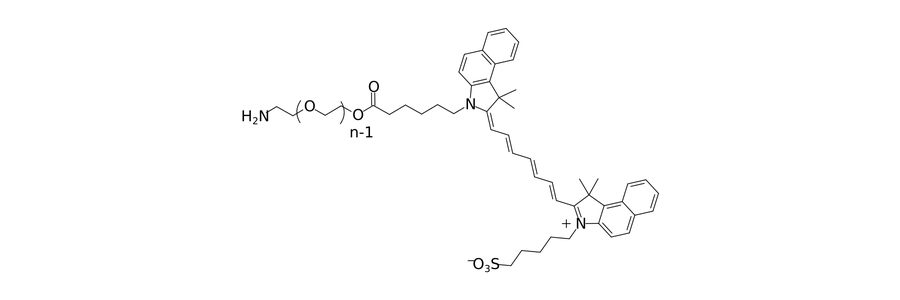
Amino-PEG Conjugate of Benzoindole Heptamethine Cyanine
Cy7.5-PEG-NH2
Precision PEG (PEG segment: approximately 2.1 kDa). An ester links a benzoindole heptamethine cyanine chromophore to a precision PEG spacer. The PEG segment in parentheses contains 47 repeat units. Custom PEG chain lengths are available at degrees of polymerization of 16, 24, 32, 45, or 64. The terminal primary amine reacts with an NHS ester to form an amide. Purified dye is available at the specified chain length, with salt form and characterization agreed on request. Applications: fluorescent protein labeling; near-infrared probe development; conjugation to fluorescent materials. Custom synthesis available.
Click to enlarge
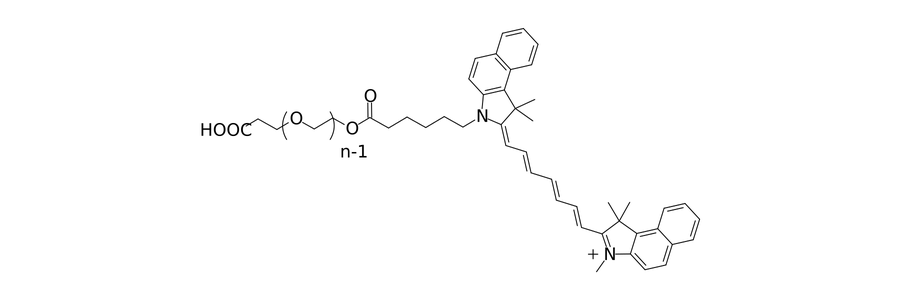
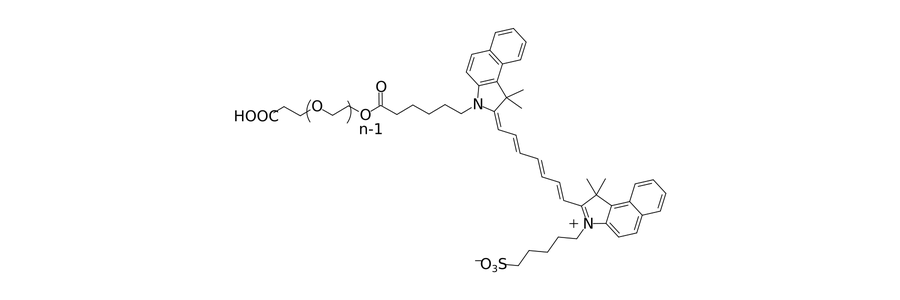
Carboxy-PEG Conjugate of Benzoindole Heptamethine Cyanine
Cy7.5-PEG-COOH
Precision PEG (PEG segment: approximately 2.1 kDa). An ester links a benzoindole heptamethine cyanine chromophore to a precision PEG spacer. The PEG segment in parentheses contains 47 repeat units. Custom PEG chain lengths are available at degrees of polymerization of 16, 24, 32, 45, or 64. After activation, the carboxyl group of the terminal propionic acid moiety (–O–CH₂–CH₂–COOH) forms an amide with a primary amine, leaving a PEG spacer between the chromophore and the labeling site. Purified dye is available at the specified chain length, with salt form and characterization agreed on request. Applications: antibody labeling; near-infrared probe development; conjugation to amine-bearing molecules. Custom synthesis available.
Click to enlarge
Hydroxy-PEG Conjugate of Monosulfonated Benzoindole Heptamethine Cyanine
ICG-PEG-OH
Precision PEG (PEG segment: approximately 2.1 kDa). An ester links a monosulfonated benzoindole heptamethine cyanine chromophore to a precision PEG spacer. The PEG segment in parentheses contains 47 repeat units. Custom PEG chain lengths are available at degrees of polymerization of 16, 24, 32, 45, or 64. The terminal hydroxyl can be esterified or further activated to make conjugation derivatives. Purified dye is available at the specified chain length, with characterization agreed on request. Applications: near-infrared probe development; fluorescent surface modification; materials tracing. Custom synthesis available.
Click to enlarge
Amino-PEG Conjugate of Monosulfonated Benzoindole Heptamethine Cyanine
ICG-PEG-NH2
Precision PEG (PEG segment: approximately 2.1 kDa). An ester links a monosulfonated benzoindole heptamethine cyanine chromophore to a precision PEG spacer. The PEG segment in parentheses contains 47 repeat units. Custom PEG chain lengths are available at degrees of polymerization of 16, 24, 32, 45, or 64. The terminal primary amine reacts with an NHS ester to form an amide. Purified dye is available at the specified chain length, with characterization agreed on request. Applications: fluorescent protein labeling; near-infrared probe development; conjugation to fluorescent materials. Custom synthesis available.
Click to enlarge
Carboxy-PEG Conjugate of Monosulfonated Benzoindole Heptamethine Cyanine
ICG-PEG-COOH
Precision PEG (PEG segment: approximately 2.1 kDa). An ester links a monosulfonated benzoindole heptamethine cyanine chromophore to a precision PEG spacer. The PEG segment in parentheses contains 47 repeat units. Custom PEG chain lengths are available at degrees of polymerization of 16, 24, 32, 45, or 64. After activation, the carboxyl group of the terminal propionic acid moiety (–O–CH₂–CH₂–COOH) forms an amide with a primary amine, leaving a PEG spacer between the chromophore and the labeling site. Purified dye is available at the specified chain length, with characterization agreed on request. Applications: antibody labeling; near-infrared probe development; conjugation to amine-bearing molecules. Custom synthesis available.
Click to enlarge
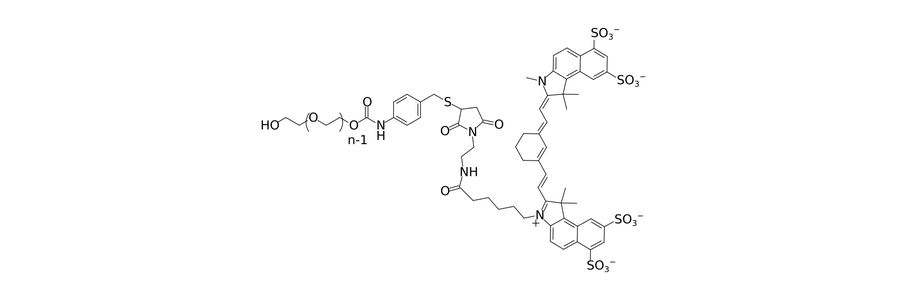
Hydroxy-PEG Conjugate of Sulfonated Cyclohexenyl-Bridged Heptamethine Cyanine
sulfo-Cy7.5-PEG-OH
Precision PEG (PEG segment: approximately 2.1 kDa). A succinimide thioether and a carbamate connect a sulfonated ring-bridged heptamethine cyanine to a precision PEG spacer. The PEG segment in parentheses contains 47 repeat units. Custom PEG chain lengths are available at degrees of polymerization of 16, 24, 32, 45, or 64. The terminal hydroxyl can be esterified or further activated to make conjugation derivatives. Purified dye is available at the specified chain length, with salt form and characterization agreed on request. Applications: near-infrared probe development; fluorescent surface modification; materials tracing. Custom synthesis available.
Click to enlarge
Amino-PEG Conjugate of Sulfonated Cyclohexenyl-Bridged Heptamethine Cyanine
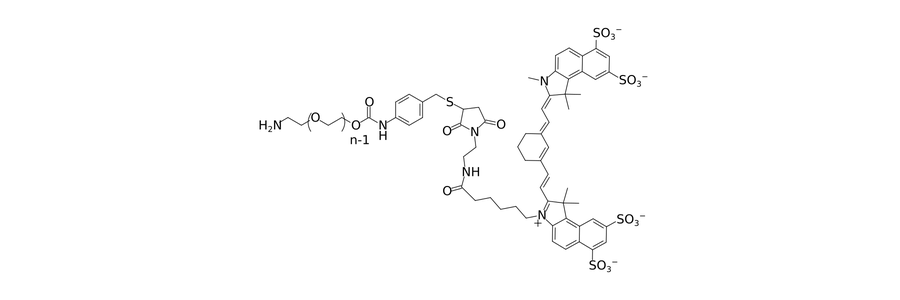
sulfo-Cy7.5-PEG-NH2
Precision PEG (PEG segment: approximately 2.1 kDa). A succinimide thioether and a carbamate connect a sulfonated ring-bridged heptamethine cyanine to a precision PEG spacer. The PEG segment in parentheses contains 47 repeat units. Custom PEG chain lengths are available at degrees of polymerization of 16, 24, 32, 45, or 64. The terminal primary amine reacts with an NHS ester to form an amide. Purified dye is available at the specified chain length, with salt form and characterization agreed on request. Applications: fluorescent protein labeling; near-infrared probe development; conjugation to fluorescent materials. Custom synthesis available.
Click to enlarge
Carboxy-PEG Conjugate of Sulfonated Cyclohexenyl-Bridged Heptamethine Cyanine
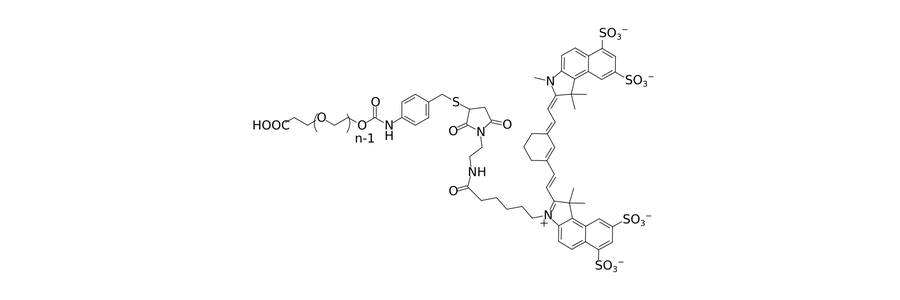
sulfo-Cy7.5-PEG-COOH
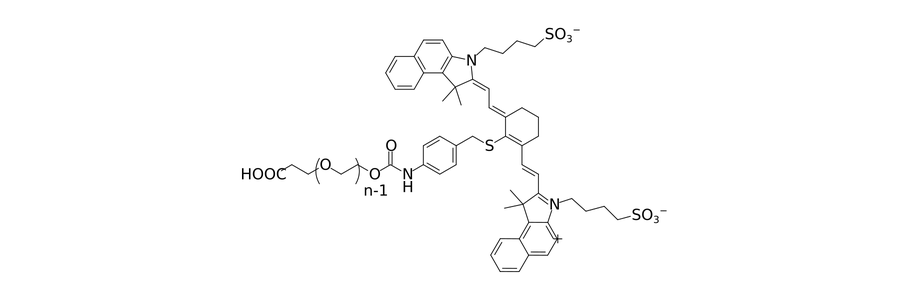
Precision PEG (PEG segment: approximately 2.1 kDa). A succinimide thioether and a carbamate connect a sulfonated ring-bridged heptamethine cyanine to a precision PEG spacer. The PEG segment in parentheses contains 47 repeat units. Custom PEG chain lengths are available at degrees of polymerization of 16, 24, 32, 45, or 64. After activation, the carboxyl group of the terminal propionic acid moiety (–O–CH₂–CH₂–COOH) forms an amide with a primary amine, leaving a PEG spacer between the chromophore and the labeling site. Purified dye is available at the specified chain length, with salt form and characterization agreed on request. Applications: antibody labeling; near-infrared probe development; conjugation to amine-bearing molecules. Custom synthesis available.
Click to enlarge
Hydroxy-PEG Conjugate of Disulfonated Cyclohexenyl-Bridged Heptamethine Cyanine
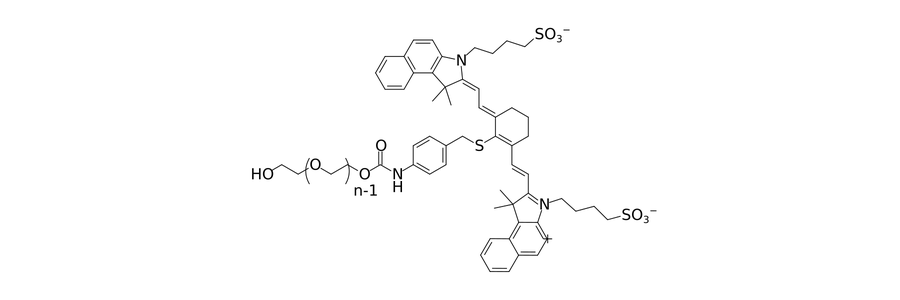
IR820-PEG-OH
Precision PEG (PEG segment: approximately 2.1 kDa). A thioether at the bridging ring and a carbamate connect a disulfonated ring-bridged heptamethine cyanine to a precision PEG spacer. The PEG segment in parentheses contains 47 repeat units. Custom PEG chain lengths are available at degrees of polymerization of 16, 24, 32, 45, or 64. The terminal hydroxyl can be esterified or further activated to make conjugation derivatives. Purified dye is available at the specified chain length, with salt form and characterization agreed on request. Applications: near-infrared probe development; fluorescent surface modification; materials tracing. Custom synthesis available.
Click to enlarge
Amino-PEG Conjugate of Disulfonated Cyclohexenyl-Bridged Heptamethine Cyanine
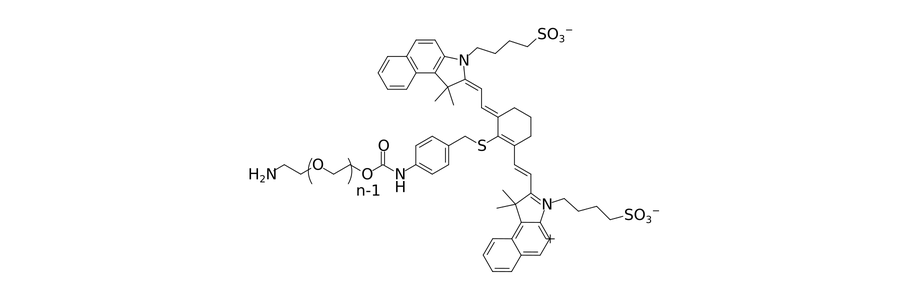
IR820-PEG-NH2
Precision PEG (PEG segment: approximately 2.1 kDa). A thioether at the bridging ring and a carbamate connect a disulfonated ring-bridged heptamethine cyanine to a precision PEG spacer. The PEG segment in parentheses contains 47 repeat units. Custom PEG chain lengths are available at degrees of polymerization of 16, 24, 32, 45, or 64. The terminal primary amine reacts with an NHS ester to form an amide. Purified dye is available at the specified chain length, with salt form and characterization agreed on request. Applications: fluorescent protein labeling; near-infrared probe development; conjugation to fluorescent materials. Custom synthesis available.
Click to enlarge
Carboxy-PEG Conjugate of Disulfonated Cyclohexenyl-Bridged Heptamethine Cyanine
IR820-PEG-COOH
Precision PEG (PEG segment: approximately 2.1 kDa). A thioether at the bridging ring and a carbamate connect a disulfonated ring-bridged heptamethine cyanine to a precision PEG spacer. The PEG segment in parentheses contains 47 repeat units. Custom PEG chain lengths are available at degrees of polymerization of 16, 24, 32, 45, or 64. After activation, the carboxyl group of the terminal propionic acid moiety (–O–CH₂–CH₂–COOH) forms an amide with a primary amine, leaving a PEG spacer between the chromophore and the labeling site. Purified dye is available at the specified chain length, with salt form and characterization agreed on request. Applications: antibody labeling; near-infrared probe development; conjugation to amine-bearing molecules. Custom synthesis available.
Precision PEG (combined PEG segments: approximately 0.79 kDa). This three-arm precision PEG has an aromatic core and three methoxy-capped arms, each with six ethylene glycol units. A single benzylic hydroxyl on the core is available for esterification or further derivatization. Purified samples and agreed chain-length and end-group characterization are available. Applications: star polymer design; hydrophilic grafting; functional material modification. Custom synthesis available.
Precision PEG (combined PEG segments: approximately 0.79 kDa). Three branching units on an aromatic core give this dendritic precision PEG six methoxy-capped terminal arms, each with three ethylene glycol units. A benzylic hydroxyl on the core is available for esterification or further derivatization. Purified samples and agreed characterization of topology and end groups are available. Applications: dendritic polymer design; hydrophilic interface studies; multi-arm material modification. Custom synthesis available.
Precision PEG (combined PEG segments: approximately 0.79 kDa). The aromatic core carries a carboxyl group and three branching units that give six methoxy-capped terminal arms, each with three ethylene glycol units. The carboxyl group can be activated for amide coupling with a primary amine. This architecture is suitable for dendritic polymer design, biomolecule conjugation, and hydrophilic surface modification studies. Custom synthesis is available.