
PRECISION POLYMER

Precision PEG: The Next Core Driver of Innovative Drug Development That CXO Companies Should Not Overlook

2026-10-26 · Case Study

PRECISION POLYMER | Industry Insights | October 2026

Advances in peptides, antibody–drug conjugates (ADCs), and nucleic acid therapeutics are bringing linkers and delivery materials into drug design at an earlier stage. For CXO companies providing contract research (CRO) and contract development and manufacturing (CDMO) services, the ability to connect material structure, quality, and application performance is becoming an important part of project development.
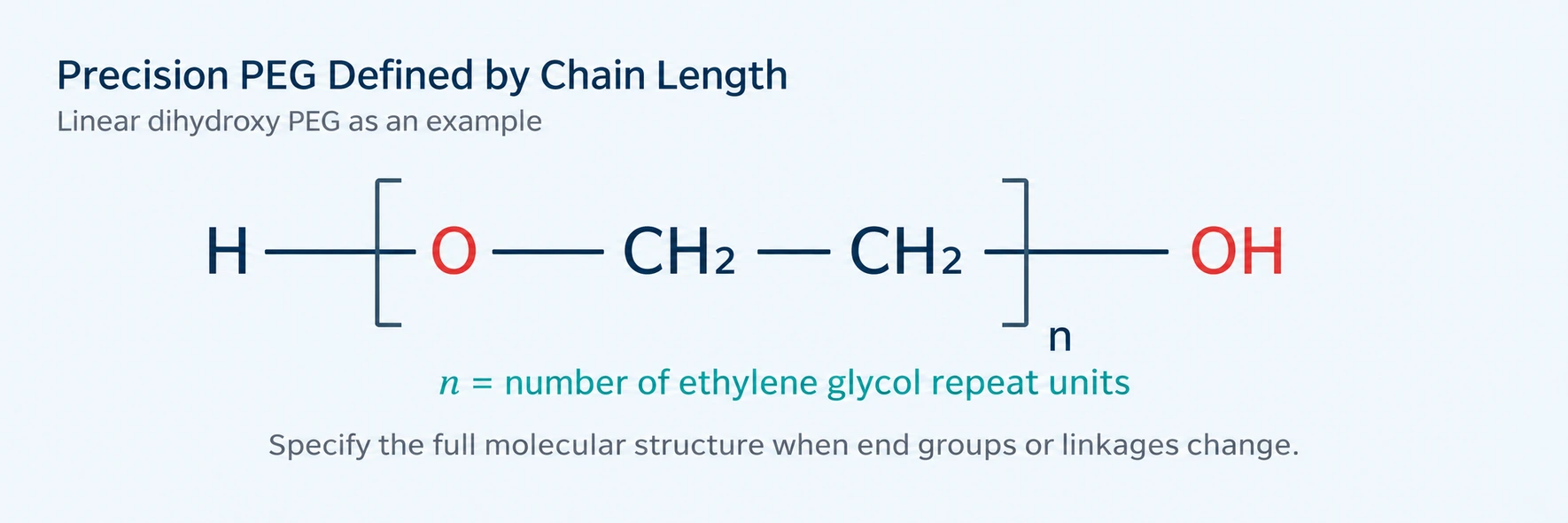
Single-molecular-weight precision polyethylene glycol, also known as discrete PEG, offers a useful direction. By turning PEG chain length from an average value into a defined molecular parameter, it provides a clearer starting point for linker screening, conjugate analysis, and studies of delivery interfaces.

Figure 1. Structural representation of linear dihydroxy PEG. End groups and the complete linkage structure must be specified separately for functional derivatives.

01 From Average Molecular Weight to Defined PEG Structures

Commonly used PEG2000 generally refers to a mixture spanning a molecular weight range. It does not mean that every chain has a molecular weight of exactly 2000 Da. The coexistence of homologues with different degrees of polymerization can complicate the separation of certain conjugation products, interpretation of mass spectra, and studies of structure–property relationships.

Precision PEG defines chain length by a fixed number of ethylene glycol repeat units. PEG24 and PEG45, for example, contain 24 and 45 repeat units, respectively. The molecular weight of the complete molecule also depends on its end groups and linkages. For derivatives, the end groups, attachment sites, and topology must also be specified.

Conventional PEG has supported the development of many established medicines. The additional value of precision PEG is to reduce chain-length distribution as a variable, making comparative molecular design easier. A single target chain length must still be supported by measured purity and impurity data; it does not replace control over conjugation sites or the number of modifications.
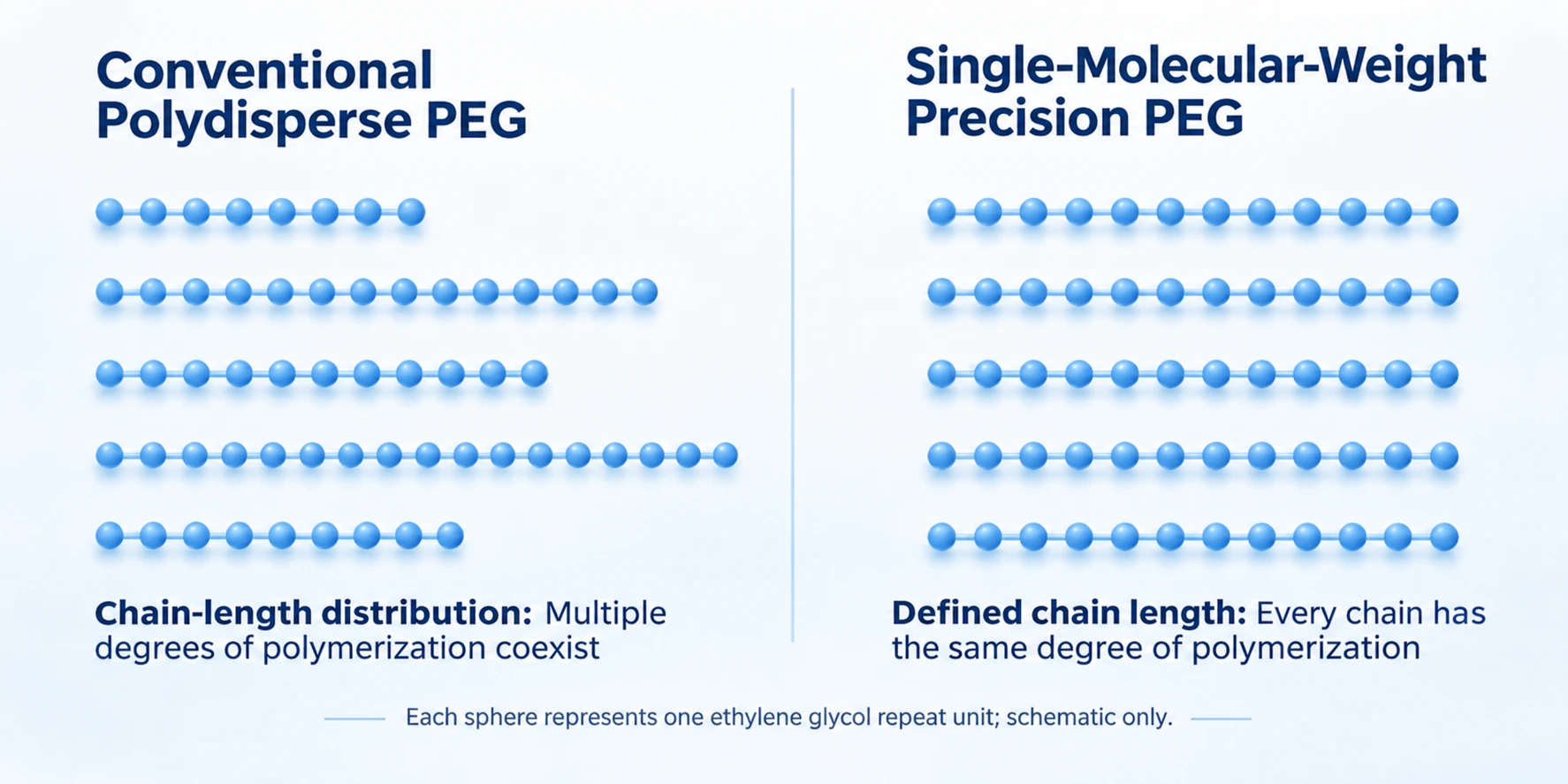
Figure 2. Conceptual comparison of chain-length distributions in conventional polydisperse PEG and precision PEG.

02 Defined Length Hydrophilic Linkers Already Have Pharmaceutical Applications

Zilbrysq (zilucoplan). This FDA-approved cyclic peptide inhibitor of complement C5 contains a PEG24 linker in its lipidated side chain. Defined-length PEG forms part of the complete chemical structure of the active drug, demonstrating how precision linkers can be incorporated directly into modern peptide drug design. [2,3]

Semaglutide. Two AEEA-type hydrophilic spacer units lie between its fatty diacid side chain and peptide backbone. These can be classified as short oligoethylene glycol (OEG) structures. Its prolonged action primarily involves fatty-diacid-mediated albumin binding, together with the peptide sequence’s resistance to enzymatic degradation. It should not be described simply as prolonged action resulting from macromolecular PEGylation. This example illustrates the importance of designing the linker together with the complete molecule. [4]

Trodelvy (sacituzumab govitecan). Its hydrolyzable CL2A linker contains a PEG segment connecting an anti-Trop-2 antibody to the SN-38 payload. The hydrophilic segment is one element of the complete linker design. ADC efficacy and safety are determined jointly by the antibody, payload, linker, and conjugation characteristics. [5]

These examples use different linker structures and mechanisms of action. Together, they demonstrate the practical development value of well-defined hydrophilic spacers and offer clear opportunities for CXO companies in linker synthesis, conjugation process development, and analytical method development.

03 Clearer Structural Analysis Offers Immediate Value for CXO Companies

The relevance of precision PEG to CXO companies can be illustrated by a specific question. When a protein conjugate produces complex mass spectra, which differences arise from PEG chain length, and which arise from conjugation sites or the number of modifications? Reducing the chain-length distribution helps separate these factors.

A study published in Nature Communications in 2024 prepared an approximately 5 kDa mPEG active ester with a precisely defined molecular weight and compared it with polydisperse PEG reagents in a bovine serum albumin model. The study showed that defined-molecular-weight PEG facilitated monitoring of reagent synthesis and identification of PEG-modified fragments by UPLC-MS peptide mapping. [1]

For teams developing chemistry, manufacturing, and controls (CMC), this suggests a practical benefit: structurally better-defined starting materials can help establish more interpretable analytical methods. In each project, method suitability must still be confirmed for the target molecule, while end-group-related impurities, unreacted starting materials, and conjugate heterogeneity must be controlled.

04 PEG Lipids Extend Chain Length Design to Delivery Interfaces

In liposomes and lipid nanoparticles (LNPs), PEG lipids help regulate particle formation, size, and colloidal stability and influence surface hydration and biological interactions. Their performance depends on PEG chain length, molar fraction, lipid anchor structure, and the overall formulation. Research on siRNA-LNPs has shown that lipid anchor chain length affects PEG lipid desorption rates, pharmacokinetics, and pharmacodynamics. [6]

Precision PEG lipids provide new tools for systematically studying these variables. Researchers can compare chain lengths while controlling other conditions, then examine protein corona formation, particle stability, and delivery performance in relation to PEG lipid content, anchor structure, and preparation conditions. Defining the length of an individual PEG chain helps explain material effects, but does not make an entire nanoparticle structurally uniform.

Immune interactions must also be evaluated. The FDA prescribing information for Zilbrysq reports anti-PEG antibodies and states that the available data are insufficient to draw definitive conclusions about their clinical impact. [2] The immune interactions and repeat-dose performance of precision PEG lipids should therefore be evaluated in the relevant formulation, administration route, and experimental system.
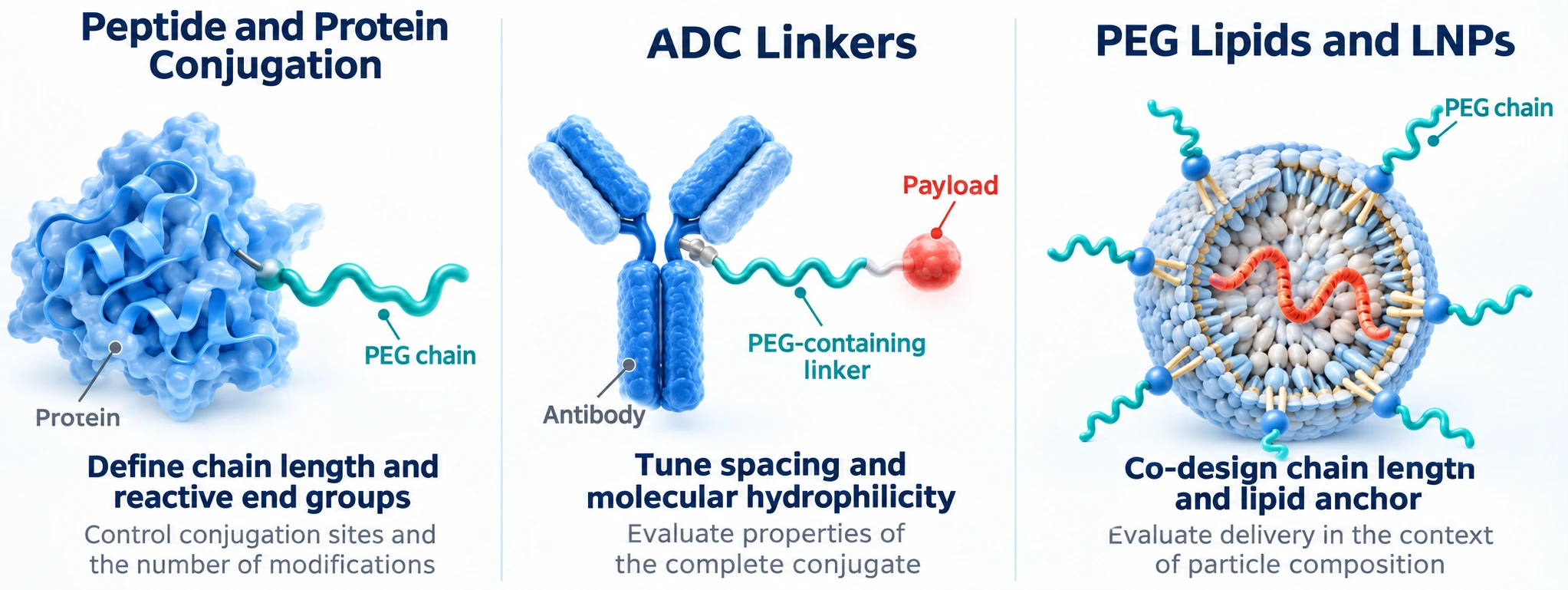
Figure 3. Functional roles of PEG in molecular conjugation and delivery interfaces. The diagram is not to scale and does not represent the detailed structure of a specific drug or LNP.

05 Turning Precision Materials into Deliverable Development Capabilities

Linker and conjugate development. For peptide, protein, and ADC projects, build libraries with different chain lengths and end groups, compare reactivity, hydrophilicity, and spacing under controlled conditions, and establish analytical methods appropriate to the complete conjugate.

Process development and reliable supply. Include target chain length, adjacent homologues, end-group integrity, and critical residuals in quality studies. Carry out scale-up, stability studies, and batch comparisons according to the intended use, progressively establishing a basis for sustained supply.

Joint formulation and delivery development. Connect precision PEG lipids and block materials with customers’ drugs and formulation platforms, selecting materials on the basis of delivery, pharmacokinetic, and safety data. For CXO companies, closer coordination between material synthesis and application evaluation can create more distinctive service capabilities.

06 Precision Polymer Collaborates on Materials for Innovative Medicines

Building on research from the University of Science and Technology of China, Precision Polymer Technologies Co., Ltd. focuses on single-molecular-weight precision PEG and its functional derivatives, precision PEG lipids, and related biomedical polymers. Its work spans molecular design, precision synthesis, structural characterization, and application research.

For peptide and protein conjugation, ADC linkers, liposomes, and nucleic acid delivery, Precision Polymer is developing precision PEG with different chain lengths and end groups, along with lipid derivatives such as PEG-DMG, PEG-DMA, and PEG-DSPE. It is also advancing quality studies and application validation for related pharmaceutical excipients.

In CXO collaborations, the value of precision materials must be demonstrated within individual projects: whether linker structures can be clearly defined, analytical results can be interpreted, processes can be scaled up reliably, and material changes can be linked to verifiable differences in application performance. Building these capabilities will provide a stronger materials foundation for the next generation of innovative medicines.

Official website: www.precisionpolymertech.com

Collaboration inquiries: sales@precisionpolymertech.com; contact@precisionpolymertech.com

References

[1] Burggraef MJ, et al. Exactly defined molecular weight poly(ethylene glycol) allows for facile identification of PEGylation sites on proteins. Nature Communications. 2024;15:9814. DOI: 10.1038/s41467-024-54076-6

[2] FDA. ZILBRYSQ (zilucoplan) prescribing information. 2023. Sections 11 and 12.6. Prescribing information and structure.

[3] Gorman DM, et al. Chemical synthesis and characterization of the complement C5 inhibitory peptide zilucoplan. Amino Acids. 2021;53:143–147. DOI: 10.1007/s00726-020-02921-5

[4] Lau J, et al. Discovery of the Once-Weekly Glucagon-Like Peptide-1 (GLP-1) Analogue Semaglutide. Journal of Medicinal Chemistry. 2015;58:7370–7380. DOI: 10.1021/acs.jmedchem.5b00726; OZEMPIC official prescribing information, Section 11.

[5] Gilead Sciences. TRODELVY (sacituzumab govitecan-hziy) prescribing information. 2026. Section 11. Prescribing information and structure.

[6] Mui BL, et al. Influence of Polyethylene Glycol Lipid Desorption Rates on Pharmacokinetics and Pharmacodynamics of siRNA Lipid Nanoparticles. Molecular Therapy Nucleic Acids. 2013;2: e139. DOI: 10.1038/mtna.2013.66

Online Consultation

WeChat Official Account QR Code

Scan the QR code with WeChat to follow our Official Account and send us a direct message.

You can take a screenshot and scan it in WeChat

China Service Hotline: 400-968-5968

Leave a Message
Full-Size Image